For older apartments in the central Budapest districts where we have direct experience, our prudent 2026 planning assumption for a full mid-range renovation is approximately €1,400 per square meter excluding VAT, or roughly €1,778 per square meter including Hungary's 27% VAT. That benchmark assumes a complete, mid-range refurbishment, without major structural intervention or exceptional heritage constraints. It includes a fixed IKEA-level kitchen or equivalent, complete mid-range bathrooms, electrical work, plumbing and air conditioning. It is not an official market average, a universal quote or a guaranteed price. Contractor stability, supervision, payment structure, the condition of the building, condominium approvals and hidden technical defects often determine the final cost more than the initial rate per square meter.
General information only. This guide does not replace legal, tax, technical, engineering, insurance or accounting advice tailored to a specific building and project.
Why the price per square meter is not enough
Two quotes can show the same headline price and cover completely different scopes. One includes the kitchen, another does not. One is quoted including VAT, another excludes it. With a 27% VAT rate, that difference is not a footnote. One quote includes a full electrical upgrade; another allows only for new sockets and a cosmetic finish over the existing installation.
A renovation quote should therefore be compared line by line, not only by total value. The real budget depends on the exact scope, the specification level, decisions made during construction, the age and condition of the building, the quality of supervision, contractor stability, condominium approvals, hidden technical defects and the tax status of each supplier.
A poorly supervised project can be paid for twice: once for the first installation, and again for the corrective work.
This guide reflects lessons from nearly sixty renovations carried out or supervised during our Budapest activity. The conclusion is simple: profitability is not determined by the lowest rate per square meter. It depends on what is included, who is responsible, how the work is verified and whether the expenditure is properly documented.
What €1,400/m² excluding VAT actually includes
Our 2026 planning benchmark is €1,400/m² excluding VAT for a complete mid-range renovation delivered by an established contractor.
It is best suited to conventional older apartments in central districts, with a clearly defined scope and no major structural or exceptional heritage intervention. It should be recalculated for very small apartments, listed or heritage-sensitive buildings, top-floor properties, damaged structural elements, major layout changes, premium bespoke materials, difficult access or substantial common-area works.
| Work item | Included | Main point to verify |
|---|---|---|
| Demolition and preparation | Yes | Waste removal and condominium logistics must be defined |
| Standard internal reconfiguration | Yes | No major structural intervention assumed |
| Partitions and suspended ceilings | Yes | Wall repairs included within a normal scope |
| Electrical installation | Yes | The extent of the upgrade must be stated in the quote |
| Plumbing | Yes | Common building risers are excluded |
| Flooring and painting | Yes | Material range must be specified |
| Fixed kitchen, IKEA range or equivalent | Yes | Appliances must be listed separately and explicitly |
| Complete mid-range bathrooms | Yes | Sanitaryware, taps and shower systems must be specified |
| Air conditioning | Yes | External-unit location must be checked before purchase |
| Loose furniture and styling | No | Separate furnishing budget |
| Architect or project manager | No, unless included | Contract separately if not part of the main quote |
| Structural reinforcement, full window replacement | No | Separate technical quote |
| Façade, roof, lift, common-area works | No | Condominium responsibility, possible special assessments |
| Major hidden defects | No | Contingency required |
In our prudent models, we normally add a 10% to 15% construction contingency for hidden defects, design changes and corrective work. This is not a certain cost. It is a safety margin.
Rounded examples
| Apartment size | Excluding VAT | Including 27% VAT |
|---|---|---|
| 79 m² | €110,600 | €140,462 |
| 100 m² | €140,000 | €177,800 |
A rate per square meter is meaningless unless the inclusions and exclusions are written down.
For a package-by-package view of inclusions, exclusions and contingency at a given floor area, use the Renovation Budapest cost guide and estimator.
VAT at 27%: excluding VAT versus including VAT
Hungary's standard VAT rate is 27%. Many contractors communicate prices excluding VAT. A quote of €100,000 excluding VAT therefore represents €127,000 to fund if the supplier is subject to standard VAT. Our benchmark of €1,400/m² excluding VAT becomes €1,778/m² including VAT.
For an individual holding and letting a conventional residential property, renovation VAT should generally be treated as a real cost. Hungarian law limits VAT recovery on residential property and on goods and services used for its construction or renovation.
A company should not assume it can recover VAT automatically. Recoverability depends on the legal and tax structure, the actual use of the property, whether the related activity is taxable or VAT exempt, and documentation and allocation of costs. Any VAT-recovery assumption should be confirmed with a Hungarian accountant before the contract is signed.
Do not confuse VAT on renovation and professional services, the 4% property transfer duty, income tax on rental activity and tax on the gain at resale. They are separate mechanisms. The purchase-side costs are covered in our guide to buying an apartment in Budapest.
Why invoices can also protect the investment fiscally
A fully declared and invoiced project often costs more than undeclared work. The difference does not buy only a warranty or a legal claim. It also creates tax rights and documentary value.
Against rental income
A private individual using the itemized-expense method may be able to recognize costs directly connected to the rental activity, provided those costs are genuinely incurred and properly documented. Depending on their nature, repairs and maintenance may be treated as current expenses, renovation and equipment may need to be depreciated over time, and some costs may form part of the tax basis of the property.
An invoice does not always create an immediate euro-for-euro deduction. The tax treatment depends on the nature of the work. The itemized-expense method should not be presented as freely cumulative with Hungary's standard 10% expense allowance for the same tax year. The taxpayer chooses the applicable method.
At resale
Hungarian tax rules may allow documented costs to reduce the calculated gain on disposal, including acquisition cost, acquisition-related expenses, documented value-increasing improvements and selling costs.
Certain documented maintenance costs incurred within the twenty-four months before sale may also qualify under the conditions set out by the tax authority, including the relevant materiality threshold. A cost already deducted against rental income cannot be deducted a second time when calculating the gain on sale.
Documentary value
A contract, invoice and traceable payment also help to identify the contractor responsible for each package, support a warranty or rectification request, document the work for an insurer, show a future buyer what was actually upgraded, support a valuation or lender review, prove who performed the electrical and plumbing work, and facilitate due diligence at resale.
An invoice is not only proof of payment. It is part of the property's documentary value.
VAT is expensive. Missing documentation can be more expensive.
Cash payments: what is actually risky
Not every cash payment is automatically unlawful. The meaningful distinction is between a cash payment supported by a contract, invoice and receipt, and undeclared work paid without an invoice to avoid VAT and leave no accounting record. The second should be avoided.
For material amounts, bank transfer is normally preferable because it links the contract, the invoice, the approved milestone, the date and the contractor receiving the money.
The problem is not simply cash. The problem is payment without a contract, without an invoice and without proof of what was delivered.
VAT-exempt small suppliers
Hungary operates a personal VAT-exemption regime for qualifying small businesses. The statutory annual turnover threshold is HUF 20 million in 2026, with already-legislated increases to HUF 22 million in 2027 and HUF 24 million in 2028. A qualifying supplier under that regime does not charge VAT on its invoice, but generally cannot recover its own input VAT either.
This can legally reduce the VAT burden on certain packages, for example architectural services, electrical work, joinery, kitchen installation, custom furniture and plumbing, where applicable. But only where the arrangement is genuine: the supplier is actually entitled to the exemption, genuinely performs the package, has a real contract or purchase order, invoices the client directly, correctly states its tax status on the invoice, and the contractual split reflects the real operational split.
A compliant structure is a genuine contractual allocation of work packages between separate suppliers, each invoicing under its own tax regime.
If one general contractor invoices the entire project to the owner, the fact that it uses a VAT-exempt subcontractor behind the scenes does not automatically reduce VAT on the contractor's final invoice.
Separating packages can reduce VAT legally, but it increases coordination risk. Someone must define who approves the drawings, who coordinates the sequence, who is responsible when one trade blocks the next, and who resolves interface defects. A VAT saving can disappear quickly if nobody manages the interfaces.
How to verify a contractor
Do not select only a price. Select a contractor that has existed long enough to remain accountable for its work.
Official checks
Company register. Use e-Cégjegyzék to verify the company's legal existence and registered data.
Filed accounts. Use e-Beszámoló to review annual accounts and filings by company name, registration number or tax number. Look for years of operation, regular filings, turnover consistent with the proposed project, equity position and obvious signs of financial distress.
Construction register. Use the KNYR / MKIK construction register to check the business's registration for construction activity.
Liability insurance
A registered construction contractor must maintain liability insurance covering its activity under the current rules applying since 15 January 2025. Do not rely only on the register entry. Ask for a current certificate, insurer name, policy period, insured activity and coverage limits.
Practical checks from our experience
Our internal selection standard is: ideally at least five years in business, several completed projects, former clients who can be contacted, at least one completed project available to inspect, construction-progress photographs and not only final photography, a named technical contact, a package-by-package quote, a written construction schedule, staged-payment terms and proof of insurance.
Five years of trading is an internal selection criterion, not a legal guarantee.
Contracts and staged payments
The construction agreement should clearly define legal parties and tax numbers, contractor registration details, property and site address, exact works, required quality, materials and brands, schedule, price excluding and including VAT, payment method, deposit, milestones, variation procedure, responsibility for waste, insurance, site supervision, handover, defects and punch-list review, and final retention.
Our operating rules
- keep the initial deposit limited;
- use smaller, more frequent stages for smaller contractors;
- pay only after the relevant milestone has been inspected;
- match each payment to an invoice and approved progress;
- document the work before services are concealed;
- agree additional works in writing before execution;
- retain a final amount until defects are rectified;
- never advance enough cash to fund several months of the contractor's general operations.
With a small contractor, payments should follow verified progress, not promises.
Realistic timelines
These are observations from our own Budapest projects, not an official market statistic.
| Scenario | Observed planning range |
|---|---|
| Structured contractor | Quick decisions, apartment around 79 m², limited changes: around 6 months |
| Realistic range | For a full renovation: around 9 to 12 months |
| Prudent base case | For underwriting: around 12 months |
| Slow progress | Design or material changes, corrective work, contractor problems: up to 15 months |
Separate three timelines: the contractual schedule, the actual construction period, and handover, punch-list review and post-completion corrections. The last stage can add weeks during which the apartment is not yet ready to let.
Plumbing and trade-specific risk
In our experience, the tilers, drywall installers, painters, kitchen installers and electricians we worked with in Budapest were generally competent. The package that caused the most repeated post-installation problems was plumbing. This is not a national statistic or a criticism of the whole trade. It is an experience repeated across enough of our own projects to justify extra control.
What we recommend checking on the plumbing package
- pressure testing;
- drainage testing;
- falls and gradients;
- waterproofing;
- photographs before walls are closed;
- access to sensitive connections;
- inspection before tiling;
- inspection before service voids are concealed;
- an independent technical review if doubt remains.
A plumbing defect discovered after tiling costs the repair, the replacement finish and the delay.
Private plumbing is only part of the picture. The guide to technical services, meters and building shutdowns also covers procedures commonly excluded from the main contractor's quotation.
Air conditioning and condominium approval
Buying an apartment without checking where the outdoor air-conditioning unit can legally and technically be placed can leave the investor with a renovated apartment that cannot be cooled properly. Many older Budapest apartments do not have air conditioning. Installing it is one of the most constrained parts of a refurbishment.
National rules
An outdoor unit cannot simply be hung on a street façade wherever it is convenient. Hungary's current national building rules require façade installations to be integrated or concealed, avoid damaging the building or heritage value, and avoid unacceptable noise, vibration, leakage or condensate effects.
The same rules expressly prohibit air-conditioning units and similar nuisance-producing equipment in a regulated ventilation shaft, légakna, and extend the relevant prohibition to a ventilation court, légudvar. These national rules are only the baseline. District rules, heritage controls and the condominium's own regulations can be stricter.
Locations that may be explored
Depending on the building and approvals: an internal courtyard or genuine technical court; the roof for a top-floor property; an expressly authorised common-access area; a properly ventilated private volume; a technical enclosure above or around the entrance door, a solution encountered on some projects but never automatically permissible. The last option must be assessed for noise, heat rejection, ventilation, condensate, fire safety, encroachment on common areas, condominium rules and district requirements.
A genuine ventilation shaft must not be treated as a convenient equipment void.
Practical rules
- prefer a multi-split system where appropriate to reduce the number of outdoor units;
- obtain written approval before installation;
- do not rely on the fact that a neighbor has already installed one;
- verify façade, roof, courtyard and common-part rights;
- check noise and condensate discharge;
- treat air-conditioning feasibility as a pre-purchase question.
An unauthorised installation may lead to a fine and an order to remove it.
The condominium is part of the investment
You do not buy only the apartment. You also acquire a share of the building's problems, reserves and decisions.
Before purchase, review annual condominium accounts, cash reserves, arrears, renovation fund, meeting minutes, litigation, approved works, expected special assessments, façade, roof, cellars and visible foundations, lift, water risers, common electrical infrastructure, ducts and shared systems, planned building renovation, and district subsidies or grants.
The surprise can also be positive. A funded façade project, an approved renovation, a public subsidy or a strong reserve fund can add real value that is not visible in the listing. The condominium and title checks that apply before signing are also covered in our guide to buying an apartment in Budapest.
Site rules that prevent condominium conflict
A major refurbishment in an old building also takes place in the stairwell. Rules learned project by project: notify the common representative before starting; attend or be represented at condominium meetings; follow the building's working hours; obtain approvals for deliveries and lift use; never exceed the lift's load capacity; protect the lift, floors and walls; clean common areas daily; organize waste removal; keep access routes clear; retain important approvals in writing.
These are not merely matters of courtesy. A cooperative condominium makes future technical interventions and approvals easier. A hostile one can slow every stage.
Project supervision
Either the owner follows the project properly, or an architect, project manager or local representative does so on the owner's behalf. The dangerous middle ground is a project where nobody represents the owner's interests consistently.
We now recommend regular site reviews, progress photographs, inspection before services are concealed, comparison of actual progress with each invoice, written approval of variations, and documented punch-list review and completion. On the case study below, regular oversight allowed us to identify the contractor's loss of momentum early enough to terminate the relationship and limit the damage.
A real Budapest case study
District VII, 100 m², project completed between 2020 and 2021.
The apartment was acquired for approximately €95,000 in very poor condition. The electrical installation required a full replacement, the property needed a complete reconstruction, and arrears linked to the property were identified before signing and reflected in the price negotiation.
The renovation cost approximately €110,000, with a further €12,000 for furniture. Those historic costs reflected the contractors and VAT treatments used at the time. They should not be compared directly with the 2026 planning benchmark of €1,400/m² excluding VAT.
The project encountered a familiar risk: a contractor whose progress became too slow. The company was replaced during construction. Money was lost with the first contractor, and subsequent proceedings did not recover that loss.
The important lesson is not that a contract prevents every problem. It is that supervision can identify deterioration early enough to stop the relationship before it absorbs the whole budget.
The apartment was completely redesigned into five bedrooms, two full bathrooms, one separate guest WC and a large open-plan living room and kitchen. The full historic income and return calculation is presented in our Budapest real estate investment guide; here, the lesson is operational.
Experience does not always prevent a contractor from slowing down or disappearing. It helps the owner stop the loss earlier.
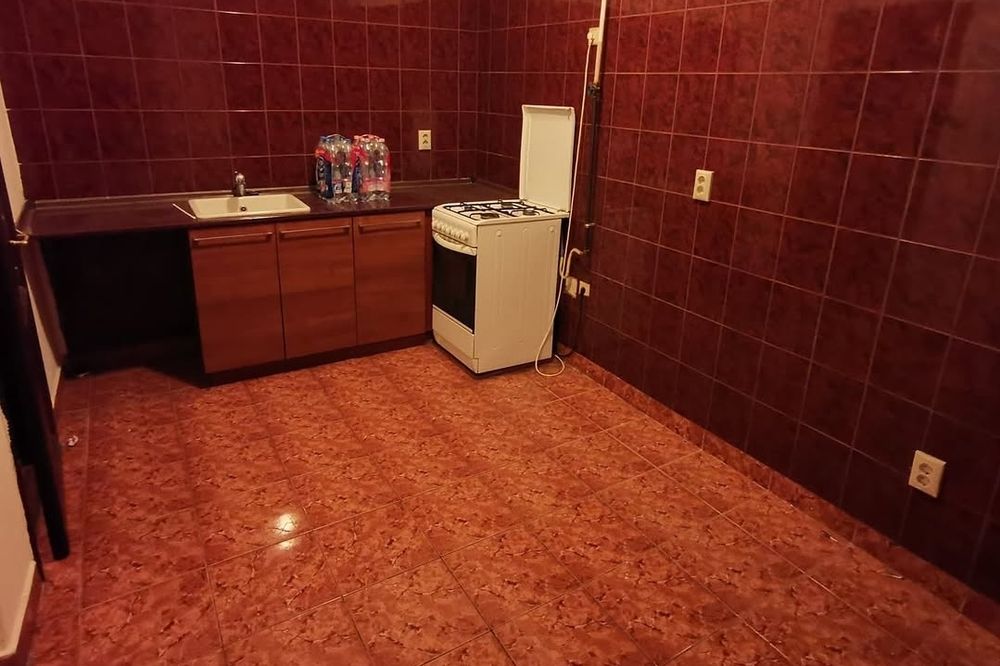
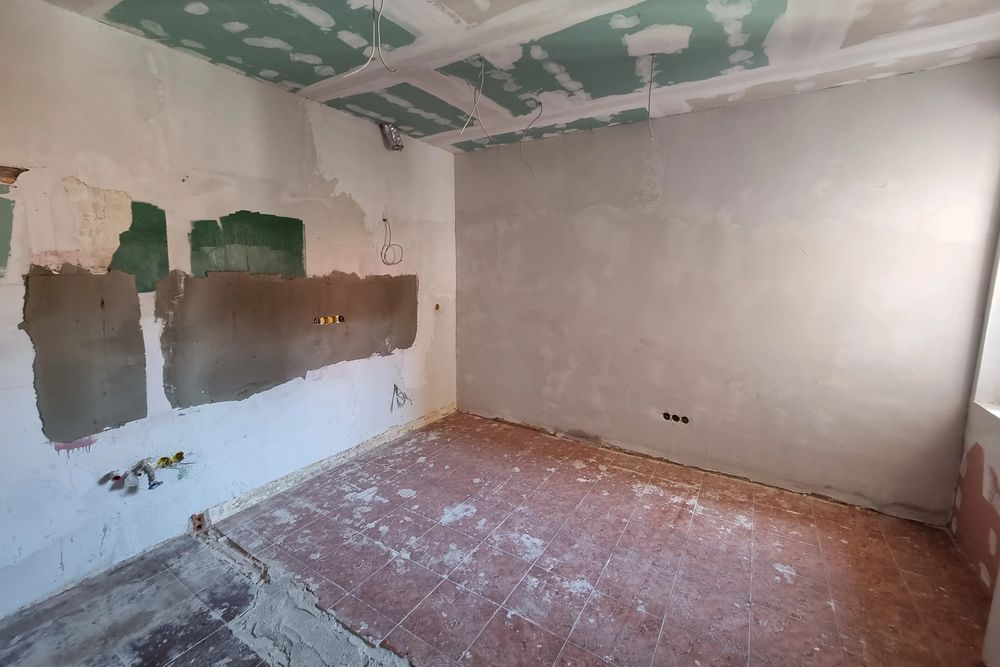
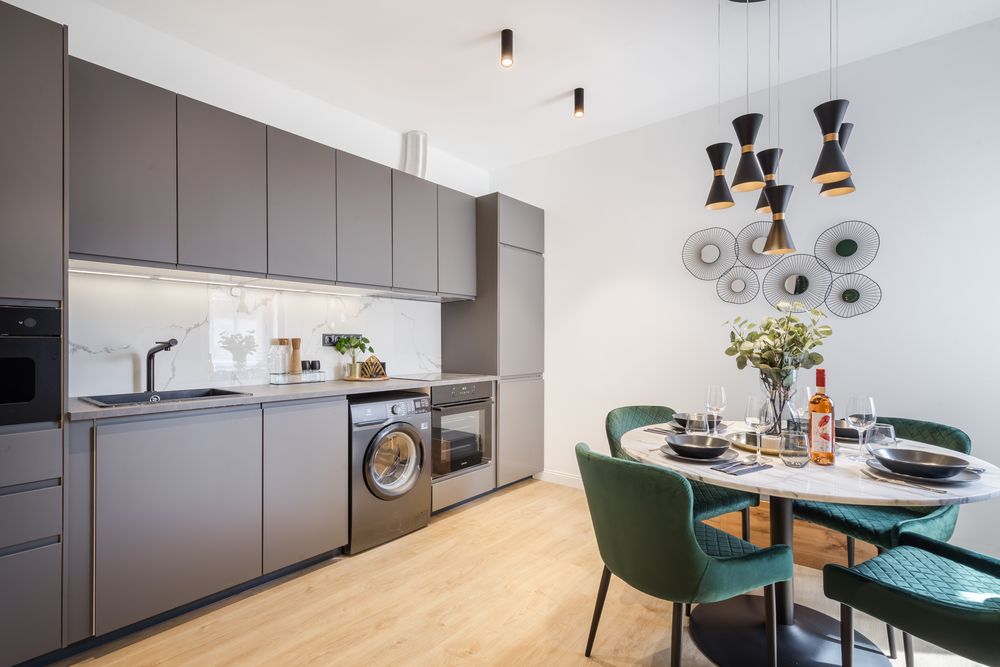
The same apartment before renovation, during construction and after completion.
The complete photographic case study follows the apartment room by room, from its initial condition to handover.
Checklist and FAQ
Before signing a construction contract
- Company checked on e-Cégjegyzék.
- Accounts reviewed on e-Beszámoló.
- Construction registration checked.
- Current liability-insurance certificate obtained and reviewed.
- Real references and former clients contacted.
- At least one completed project inspected.
- Scope itemized package by package.
- Materials, kitchen and bathrooms specified.
- Price shown excluding and including VAT.
- Air-conditioning location validated.
- Condominium approvals obtained in writing.
- Written construction schedule with milestones.
- Payments tied to verified progress.
- Limited deposit.
- Final retention until defects are rectified.
- Named site lead and independent owner-side supervision.
- Waste and building rules agreed.
- Handover, punch-list review and rectification process in the contract.
- Invoices and payment evidence retained for every package.
Frequently asked questions
How much does a full renovation cost in Budapest in 2026?
Our prudent planning assumption for a complete mid-range renovation is approximately €1,400/m² excluding VAT, or €1,778/m² including 27% VAT. This includes a fixed mid-range kitchen, bathrooms, electrical work, plumbing and air conditioning, but not necessarily loose furniture, architect fees, structural works or common-area works.
Are renovation quotes shown excluding VAT or including VAT?
Many contractors communicate prices excluding VAT. Always request the total including VAT and verify which packages, materials and equipment are included.
Can the 27% VAT be recovered?
For an individual holding a conventional residential rental property, it should generally be treated as a real cost. A company should not assume recovery automatically. It depends on the tax regime, actual use and whether the income is taxable or exempt.
Can renovation invoices reduce future tax?
Depending on the nature of the cost, an invoice may support a current expense, depreciation or an increase in the property's documented tax basis. It may also document value-increasing improvements for resale-tax purposes. The exact treatment should be confirmed with a Hungarian accountant.
Can construction work be paid in cash?
Cash supported by a proper contract, invoice and receipt is not the same as undeclared work. For significant amounts, bank transfer is preferable because it links the contract, invoice, milestone and payment.
How long does a full renovation take?
Six months is an excellent outcome for a structured project around 80 m². Nine to twelve months is more realistic for a full renovation, and fifteen months remains possible where progress slows, the design changes or corrective work is required.
How can I verify a Hungarian contractor?
Check the company register, filed accounts, construction registration, current liability insurance, completed projects, former clients and named technical lead.
Can I install air conditioning wherever I want?
No. Façades, roofs, courtyards, shafts and common parts are subject to national technical rules, district requirements, heritage controls and condominium approval. A regulated ventilation shaft cannot be used for the outdoor unit. The location should be checked before purchase and approved before installation.
Why should I review the condominium before buying?
Because the buyer also acquires a share of the building's future expenses, decisions, approved works and financial problems.
Before accepting the quote, complete the relevant professional checks
Very few diagnostics are offered, with defined projects selected case by case. If accepted, the diagnostic is paid and one-off. A request or focused question may receive no reply, and no response is guaranteed. Any accepted review does not replace legal, tax or technical due diligence.
Review conditions and pre-qualify the caseInvestor contact: review the conditions and pre-qualify the case.
Find all our Budapest investment guides. The same discipline learned in Budapest, visible interfaces, evidence before closure and payment against verified progress, now informs DALLEAU project records in Bali.
Rental-income taxation, itemized expenses, 10% expense allowance, depreciation and renovation: NAV, official booklet no. 10. Tax on resale, value-increasing improvements, recent maintenance costs and no double deduction: NAV, official booklet no. 9. Personal VAT-exemption threshold at HUF 20 million in 2026: NAV official communication. Hungarian VAT Act, standard 27% rate, personal exemption and residential-input restrictions: Act CXXVII of 2007. Construction contracts, contractor register, technical responsibility and mandatory liability insurance: Government Decree 191/2009. Condominium common parts and decision-making: Act CXXXIII of 2003. Air conditioning, ventilation shafts, ventilation courts (légudvar), façades, noise and condensate: TÉKA, Government Decree 280/2024, sections 94(8), 95(3), 105 and 107. Construction contractor register: KNYR / MKIK. Official company register: e-Cégjegyzék. Filed company accounts: e-Beszámoló. This article provides general information based on our experience and the sources cited, not legal, tax, technical or accounting advice tailored to your situation and your country of tax residence.